
BATTERY REPLACEMENT HANDBOOK
A better decision starts
with a little understanding.
A battery problem can interrupt an ordinary morning, a planned journey or a car that has been parked for a while. The useful question is what to check next. These notes take you through the thinking behind inspection, testing, choosing a replacement and looking after it afterwards. Read them in order for the whole picture, or jump to the part that matches your situation.
Keep your vehicle manual beside you. This page concerns conventional 12V car batteries, and its examples are general. Your vehicle's instructions determine the equipment, sequence and specialist work needed. The aim is to help you prepare better questions and recognise the limits of a quick replacement, whether you complete a suitable job yourself or ask a technician.
A flat battery is a clue. Start there.
Describe the problem before deciding on the solution.
Separate what happened from what caused it
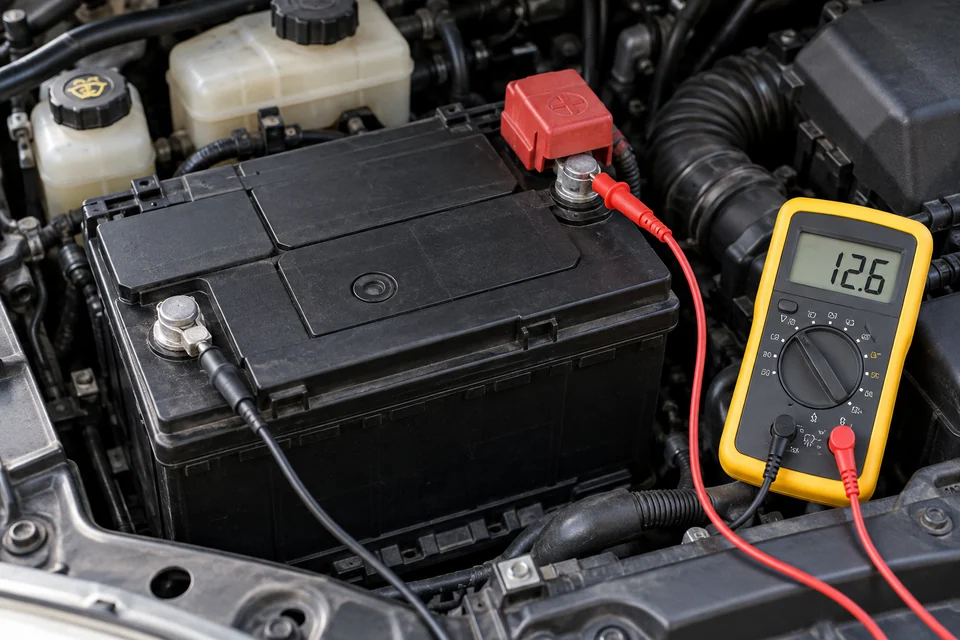
“The car would not start” describes an experience. “The battery needs replacing” is a conclusion that still needs support. Slow cranking, dim lights and repeated starting trouble can be associated with a discharged battery, but loose connections, electrical drains and charging problems can also be involved. Interstate Batteries explains these overlapping symptoms. That is why buying a replacement immediately may leave the underlying problem unanswered.
Begin with a short description in your own words. Did the starter turn slowly, did you hear a click, or did nothing happen when you tried to start? Were any dashboard messages present? Was this the first occurrence or part of a pattern? You do not need to turn those observations into a diagnosis. Their value is that they give the next inspection or workshop conversation something concrete to work with.
Make the recent history part of the picture
Write down anything relevant about the days before the problem. Perhaps the car had been parked, an interior light was left on, or an accessory was recently added. Perhaps the difficulty followed a cold morning, or happened after an otherwise normal drive. None of these details proves the cause. Together, however, they help you ask a better question than simply whether the battery is “good” or “bad”.
Also note what happened after any previous assistance. If the car needed a jump-start, record the date and whether the problem returned. A successful start is an observation, not the end of the investigation. Resist the temptation to erase the first incident from your mental picture because the next morning went well. A brief written history is easier to explain accurately than a collection of remembered impressions.
Record the symptom, when it happened, what had changed and what happened afterwards. Take that note to a battery or charging-system check. It helps you choose the next action without pretending the cause is already known.
Inspect what you can see. Respect what you cannot.
A careful observation is more useful than a hurried assumption.
Find the right information before the right tool
Start with the battery location and inspection guidance in your vehicle manual. Do not assume that a photograph of an engine bay describes your car. If you cannot identify the battery, its connections or the permitted access route confidently, that is a good point to seek help. Read any relevant warning labels without removing covers or components simply to make the arrangement look more familiar.
Where the manufacturer permits a visual check, look at the general condition of the case, cables, connections and mounting. Note anything that appears damaged or out of place. Visible corrosion deserves attention: VARTA's maintenance guidance explains that terminal corrosion can affect performance and present a hazard. Looking at a connection is different from being authorised or equipped to clean, loosen or repair it.
Make your observations easy to revisit
If it is safe to do so, take a clear photograph of the visible battery label and overall arrangement. Keep the image as a reference for a parts enquiry or technician. Do not use a photograph as a substitute for the manufacturer's procedure. A useful image records what is there; it does not explain which parts should be disconnected, what torque is required or which settings need attention afterwards.
Divide your notes into three categories: what looks normal, what needs checking and what you cannot assess. This avoids treating uncertainty as evidence that everything is fine. For example, you may be able to read the battery type while being unable to judge whether a cable connection is sound. There is no benefit in forcing an answer to the second question just because the first one was easy.
You can finish an inspection with a useful list of questions rather than a completed repair. If the case looks damaged, liquid appears to be escaping or the arrangement is unfamiliar, leave the battery alone and ask a qualified technician to assess it.
A number needs context.
Understand what a test answers before acting on its result.
Charge and condition answer different questions
A voltage reading can help indicate a battery's state of charge, but it does not by itself establish its overall condition or starting capability. VARTA distinguishes state of charge from state of health and describes the additional testing needed for modern battery technologies. The useful takeaway is to treat one reading as part of an assessment rather than a universal replacement instruction.
Before arranging or attempting a check, decide what you want to learn. Are you trying to understand a one-off discharge, confirm a replacement recommendation or investigate a recurring starting problem? Those are different questions. Tell the person performing the test about the symptom and recent history. A reading detached from that history can be harder to interpret and less useful when you need to choose an action.
Ask for the meaning, not just the measurement
If a workshop tests the battery, ask for a plain explanation of the result. What was checked? Is the recommendation to charge and retest, investigate another problem or replace the battery? Does the result explain the difficulty you reported? You are not challenging the technician by asking. You are making sure that the recommendation and your understanding refer to the same problem.
Keep any report with your notes. Record the date, battery identification and the recommendation given. If you need another opinion later, share the original report rather than summarising it from memory. This is especially useful when several people have helped with the car and each has seen it under different circumstances. A clear record gives the next conversation a starting point without making you interpret technical data yourself.
- A charge question
- Ask whether the battery needs appropriate charging and another assessment.
- A condition question
- Ask what the test says about the battery's ability to do its job.
- A recurring-problem question
- Ask whether connections, charging or an electrical drain also need investigation.
Choose a 12V car battery for your vehicle.
The best car battery for your vehicle starts with the approved specification.
Choose a new car battery for your vehicle
Compare car batteries by vehicle specification. Choose a replacement battery using the correct vehicle details and the manufacturer's requirements. Confirm the intended battery technology, physical fit, connection arrangement and any installation requirements with a reliable supplier or technician. The old label is useful evidence, but it should not be your only reference: you may not know whether a previous owner fitted the correct replacement.
A 12 volt car battery must match the required technology, terminal layout and cold cranking amps (CCA) specification. Battery technologies are not simply interchangeable names. VARTA's explanation of EFB and AGM batteries describes technology-specific replacement requirements, including retaining AGM where AGM is required. Follow the exact vehicle specification and approved replacement guidance. An item that fits the available space is not automatically the right battery for the electrical system.
Compare car battery prices and complete installation costs
The car battery replacement cost guide explains how to compare the battery, fitting and any registration charges.
When you compare suppliers, write the proposed specification next to each quote. Also ask what the quote includes: the battery alone, fitting, testing, any necessary registration and the return of the old battery. This makes the comparison more meaningful. A smaller headline price tells you little if you still need to arrange other parts of the job separately or cannot confirm what you are buying.
When comparing cheap car batteries, confirm the required specification and read the supplied warranty before deciding. Keep the receipt. Ask how a concern would be assessed and which purchase details you would need to provide. There is no need to assume that every seller handles the process in the same way. Your goal is to understand the option in front of you, including its specification and practical support, before committing to it.
Record the vehicle, confirmed battery specification, supplier, installation arrangements and any registration requirement. If two recommendations conflict, resolve the difference with the vehicle instructions or a qualified technician before ordering. The right question is whether the whole choice suits your car, not whether the name sounds familiar.
Prepare for car battery installation.
A straightforward replacement depends on what happens beforehand.
Decide whether this is a suitable job for you
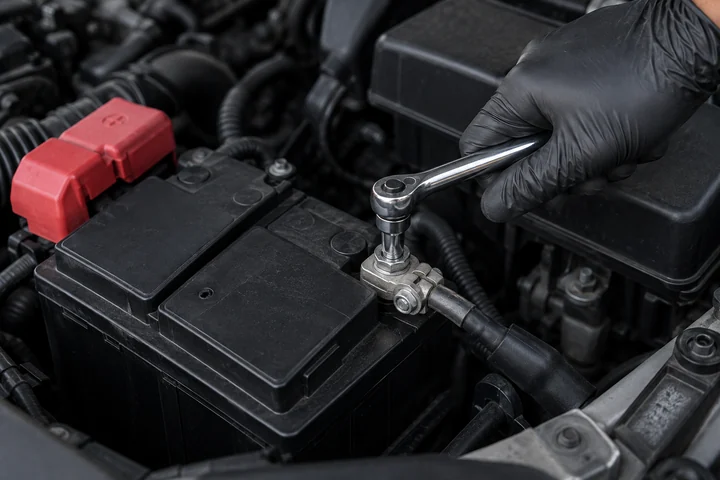
Read the complete vehicle procedure before touching a connection. Pay attention to access, required equipment, electrical shutdown instructions and any work needed afterwards. Ask whether you understand each part and can complete it with the equipment and experience you have. If the answer is uncertain, arrange assistance first. Discovering an essential requirement halfway through is a poor time to decide how to meet it.
Battery work involves electrical and chemical hazards. VARTA's battery replacement safety instructions cover precautions such as appropriate eye and hand protection and avoiding ignition sources. Use the vehicle and battery instructions together. A familiar-looking battery is not a reason to skip the precautions or improvise around a warning you do not understand.
Arrange the job from beginning to end
Check the tools needed to remove and install a car battery before starting. Read the battery disconnection overview alongside your vehicle instructions.
Check that the correct replacement is available, that the work location suits the manufacturer's requirements and that you can keep necessary information accessible. Have a plan for the old battery as well as the new one. If a technician will handle registration or another specialist step, confirm that arrangement before the work begins. Preparation should include the final checks, not just the moment the old battery comes out.
Allow enough time to work carefully and stop if the arrangement differs from what you expected. The ten-minute title describes the idea of a clear, manageable process; it is not a stopwatch target for every car. Access, preparation and vehicle requirements can change the job considerably. Finishing quickly has little value if an unanswered question is carried into the installation.
Do I have the correct procedure? Do I have the correct replacement and required equipment? Do I understand what must happen after installation? If any answer is missing, use that question to guide your preparation or conversation with a technician.
Understand car battery replacement step by step.
The overview helps you organise a vehicle-specific procedure.
Think in stages, not in isolated actions
The sample checklist divides replacement into preparation, removal, installation and final checks. That structure helps you see where an instruction belongs. It is not a substitute for the detailed sequence required by your car. Read through the full procedure and identify the start and finish of each stage before beginning. Knowing the next stage reduces the chance of treating a partially completed job as a finished one.
Connection order matters, and disconnection and reconnection should not be assumed to use the same sequence. The correct handling procedure must come from your vehicle instructions. Do not infer it from the position of a cable in an illustration. Similarly, tightening requirements, mounting arrangements and any attached sensors deserve their own instructions rather than an assumption that every visible part is handled the same way.
Pause when the real arrangement differs
Use the guide's overview to keep your place, but compare the actual vehicle with its instructions at each stage. If a cover, cable, mounting or connector does not match what you expected, stop and resolve the difference. Pulling harder, choosing another tool by guesswork or continuing because the first steps seemed easy can turn a manageable question into a larger problem.
A sensible pause is part of completing the work responsibly. Keep track of what has already been done so that a technician can understand the vehicle's current state if help is needed. You do not need to explain why the arrangement is different. Describe the point where you stopped and the part you could not identify or handle according to the procedure.
Each action has a reason, belongs to a stage and ends with a check before the next action begins. Use that rhythm to organise the manufacturer-approved work. The most useful checklist is one that helps you notice a missing instruction, rather than encouraging you to continue past it.
The first start is a checkpoint.
Finish the job with the checks your vehicle requires.
Return to the procedure's final checks
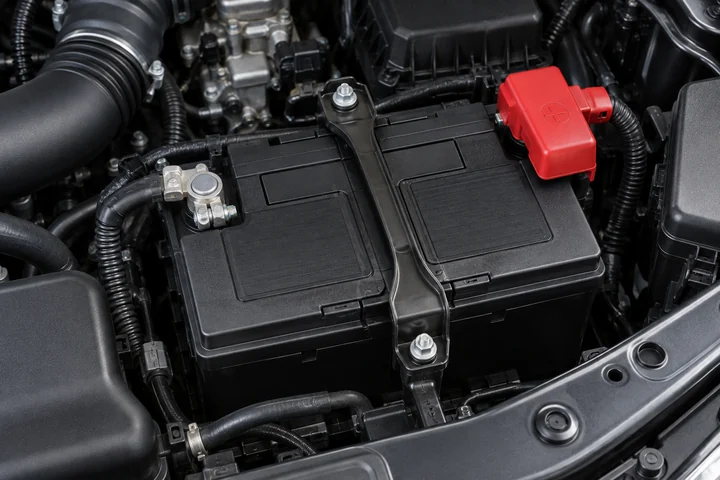
A vehicle starting again is encouraging, but it does not answer every question about the installation. Follow the manufacturer's completion checks for the mounting, connections, covers and any work required after power has been restored. If you used a technician, ask what was checked and whether any follow-up remains. This keeps the meaning of “finished” clear for everyone involved.
Compare the outcome with the problem you originally recorded. Does the car behave as expected, and are there messages or symptoms that still need attention? Do not dismiss an unresolved issue because one part of the experience improved. Record what changed and what did not. That distinction is useful if another assessment is needed, and it avoids treating a successful replacement as proof that every earlier symptom had the same cause.
Keep the important details together
Save the installation date, battery specification, receipt, warranty information and any test report in one place. Include the details of specialist work that was performed, if applicable. A photograph or digital folder is often enough to keep the information accessible. The value is continuity: a future question about the battery starts with a clear record rather than a search through several unrelated messages.
Plan what will happen to the old battery. Lead-acid batteries belong in an appropriate collection or recycling route. Interstate Batteries' recycling information explains its collection approach. Ask your supplier or a local authorised service about the options available where you live and how the battery should be handled and transported. Arrange this before leaving the old battery somewhere unsuitable.
The completion record should say what was fitted, which required checks were completed, whether any issue remains and where the old battery will go. It is a small amount of paperwork that makes the result easier to understand now and easier to revisit later.
Good care starts with your ordinary routine.
Notice how the car is used, parked and maintained.
Make the driving pattern part of maintenance
Battery care is easier to think about when it reflects how the car is actually used. Frequent short trips and extended periods parked are useful details to discuss when planning maintenance. Temperature matters too: heat can contribute to deterioration, while cold conditions can make a weakened battery's starting difficulty more apparent. Interstate Batteries discusses driving patterns and temperature in its explanation of battery life.
Avoid turning that general information into a promise that one extra journey or a fixed number of minutes driving will solve a charge problem. Instead, describe your normal use to a technician and ask whether an appropriate charging or maintenance arrangement is needed. If charging is recommended, confirm equipment compatibility and follow the vehicle, battery and charger instructions. A care habit should suit the actual system.
Build a small record rather than a complicated routine
Add a battery reminder to the maintenance system you already use for the car. It might be a note in the service folder or a question you raise before a period of reduced use. Record any starting trouble and the action taken rather than trying to remember whether it was “about the same” as last time. Consistency in the notes is more useful than making them technically elaborate.
Consider accessories in the same practical way. If you add equipment or change how you use existing devices, keep that information with the vehicle record. A future discussion about an electrical problem is easier when changes are documented. Do not assume that an accessory caused the problem, but do not leave it out of the history simply because it appeared to work normally.
Know your normal driving pattern, keep the required maintenance guidance accessible and make a note when the pattern changes. Ask for advice before long storage or when starting behaviour becomes different. The goal is timely attention, not a guarantee that a battery will last a particular number of years.
Knowing when to ask is part of knowing what to do.
Use the guide to make a workshop conversation more useful.
Identify the requirement you cannot meet
Some vehicles need the replacement battery registered or coded through a diagnostic process. Others use systems that learn the battery's characteristics differently. VARTA explains these battery-management differences. Check the exact requirement for your car before replacement. A generic claim about a vehicle brand is less useful than the procedure for the model and configuration you actually own.
Specialist help can also be appropriate when access is difficult, the battery appears damaged, symptoms keep returning or the required procedure is unclear. State the practical reason for seeking assistance. “I cannot confirm the registration requirement” gives a workshop a more precise starting point than “I am worried about the battery”. Clear questions help you understand what work is being proposed and why.
Take your information, then ask for a complete explanation
Bring the symptom history, relevant photographs, previous test reports and any replacement specification you have been given. Tell the technician if someone has already worked on the car and what was done. Keep observations separate from conclusions: explain the starting behaviour you noticed rather than presenting an unconfirmed cause as a fact. That leaves room for the assessment to answer the actual question.
Before agreeing to work, ask what is included and what the result is expected to establish. Is the battery being assessed on its own, or are other parts of the starting and charging system also involved? If replacement is recommended, what specification and completion procedure will be used? These questions are about understanding the job; they do not require you to second-guess equipment or perform the diagnosis yourself.
Explain the symptom, share the history, identify what you could not confirm and ask which checks or procedures are needed next. A good guide helps you arrive prepared, even when the right next step is for a qualified person to carry out the work.
One guide. A clearer place to begin.
Use the PDF alongside the information for your vehicle.

Read for understanding before reading for action
The Battery Guide concept follows a simple progression: inspect, test, replace and protect. The sample pages show how that progression can bring photographs, short explanations and checklists together. Start by understanding the whole sequence, then return to the part that matches your immediate question. This makes the guide a reference you can consult deliberately rather than a set of instructions you first encounter while working.
When comparing an illustration with your car, separate the general idea from the vehicle-specific detail. A picture can help explain the purpose of a check or the shape of a familiar component. It cannot establish your required battery specification, connection procedure or registration steps. Keep the vehicle manual available and use any difference between the picture and the car as a question to resolve, not something to ignore.
Make the digital format work for your situation
A PDF can be opened on a phone, tablet or computer with a suitable reader. Choose the device that makes the information easiest to read, and zoom into an illustrated page when needed. The sample spread on this website can also be opened at full size. Read relevant material somewhere comfortable before the job so that your first look at a page is not competing with an unfamiliar physical task.
Keep your own notes separate from the guide. Write down the vehicle details, confirmed specification and questions that remain, then refer back to the appropriate section. This gives you a personal record without confusing general educational content with instructions confirmed for your car. Whether you are preparing for a suitable replacement or arranging professional help, the most valuable outcome is a next step you can explain clearly.
Understand the signs, organise the checks, prepare for the required process and build sensible care habits. It does not guarantee a ten-minute job or replace specialist procedures. Review the sample pages and the product questions to decide whether that approach fits what you want to learn.